
37 Dokumente gefunden
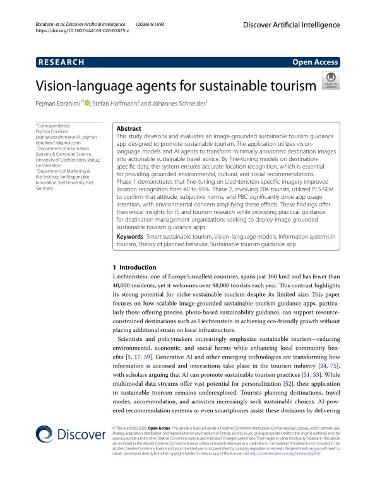
Vision-language agents for sustainable tourism
This study develops and evaluates an image-grounded sustainable tourism guidance app designed to promote sustainable tourism. The application utilizes vision-language models and AI agents to transform minimally annotated destination images into actionable sustainable travel advice. By fine-tuning models…
[Cham]: Springer Science and Business Media LLC, 2026
Leadership and Well-Being : Bidirectional Effects and Contingencies
Leadership and employee well-being are closely intertwined in contemporary organizations. While leadership is widely regarded as a central social influence shaping employees’ well-being, growing evidence suggests that leadership–well-being relationships are more complex than traditionally assumed. Across…
Essays on Moral-Psychological Rebound Effects and Feedback Interventions for Sustainable Consumer Behavior
This dissertation examines moral-psychological rebound effects and feedback interventions in the context of climate-friendly consumer behavior. While measures such as energy efficiency improvements, sufficiency-oriented consumption, or carbon offsetting aim to reduce greenhouse gas emissions, their intended…
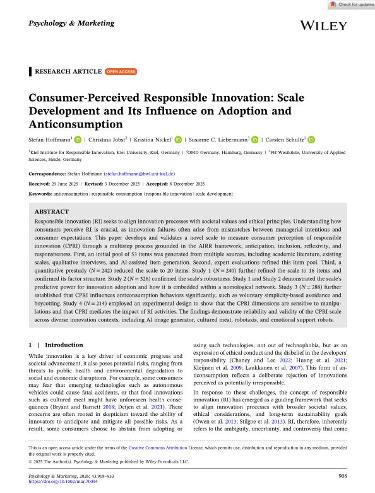
Consumer‐Perceived Responsible Innovation: Scale Development and Its Influence on Adoption and Anticonsumption
Responsible innovation (RI) seeks to align innovation processes with societal values and ethical principles. Understanding how consumers perceive RI is crucial, as innovation failures often arise from mismatches between managerial intentions and consumer expectations. This paper develops and validates…

In memoriam Prof. Dr. Christian Blecher (1976–2026)
Nachruf auf Prof. Dr. Christian Blecher (1976–2026), der als Professor für Rechnungslegung und Wirtschaftsprüfung an der Christian-Albrechts-Universität zu Kiel wirkte.
Kiel: Universitätsverlag Kiel | Kiel University Publishing, 2026
Dissociation of morality and performance : Essays on the concept of moral decoupling
This dissertation examines moral decoupling, the process by which consumers separate performance from morality judgments, to explain immoral or unsustainable behaviors. Through six studies, it explores how fear influences moral judgment in public health and hoarding contexts, sometimes overriding reasoning,…
The Circular Household Model : A Framework for Implementing Circular Economy at the Micro Level
Rising global resource consumption and waste generation highlight the urgent need for change. This whitepaper focuses on the transition from a linear to a circular economy (CE) by taking a deeper look on the role of consumers within the CE. While existing research frequently focuses on the macro, meso…
Essays on the Explanatory Power of Parallel Process Models : Application to Online Services, Brand Heritage and Unethical…
This cumulative dissertation seeks to understand consumer reactions towards various stimuli, such as online services (online service environments, virtual conversational agents [VCA ]), brand heritage and corporate transgressions. A total of eight empirical research papers employ mixed methods to help…
A longitudinal study of consumer animosity: the case of the US presidential elections
Purpose: This study investigates the longitudinal effects of animosity towards the US following the 2020 presidential election and provides insights into how political events influence consumer animosity and willingness to buy. Design/methodology/approach: This study used a survey-based within-subjects…
Nudging Sustainable Consumer Behavior
Humanity is increasingly facing the pressing challenges of today’s interconnected environmental and health crises. Especially, climate change and obesity pose two of the greatest threats to the world population. These threats are exacerbated by the profound impacts of current food production and agricultural…
Self-Related and Society-Related Benefits in (Pseudo-) Sustainable Consumption. : A Multi-Perspective Approach
This dissertation investigates consumers’ motivations, behaviors and responses to various stimuli in a specific context: sustainable business models, that provide both, self-related and society-related benefits and can potentially induce pseudo-sustainable consumption. It further exploits the diverging…
Essays on consumer animosity and misinformation as challenges for global markets
This dissertation simultaneously investigates the topics of consumer animosity and misinformation as challenges for companies operating in multiple countries. This dissertation includes five essays (two literature reviews—including one meta-analysis—, two survey studies, and experimental studies). Essay…
Age Bias in Leadership : Antecedents, Mechanisms, and Contingencies
This dissertation examines age biases against young leaders, spotlighting the antecedents, mechanisms, and contingencies underlying this phenomenon. As organizations embrace age diversity, leadership roles continue to be overshadowed by implicit and explicit biases against young leaders. Essay 1 investigates…
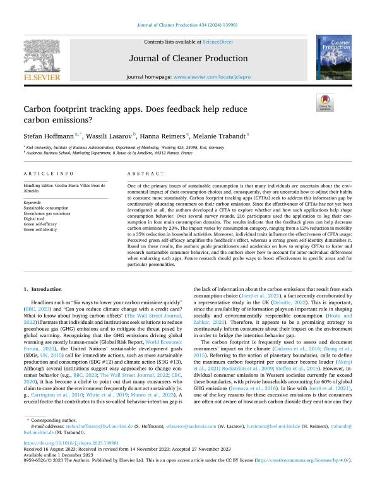
Carbon footprint tracking apps. Does feedback help reduce carbon emissions?
One of the primary issues of sustainable consumption is that many individuals are uncertain about the environmental impact of their consumption choices and, consequently, they are uncertain how to adjust their habits to consume more sustainably. Carbon footprint tracking apps (CFTAs) seek to address…
Essays on the Management of Employee Innovativeness
This dissertation explores the determinants of employee innovativeness in a more dynamic context. Thereby, it examines how to organize innovation management to enhance employees’ 1) engagement in idea generation and 2) acceptance of innovation implementation. The focus is on employees in established…
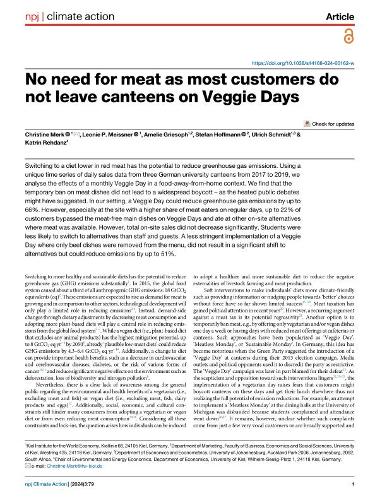
No need for meat as most customers do not leave canteens on Veggie Days
Switching to a diet lower in red meat has the potential to reduce greenhouse gas emissions. Using a unique time series of daily sales data from three German university canteens from 2017 to 2019, we analyse the effects of a monthly Veggie Day in a food-away-from-home context. We fi nd that the temporary…
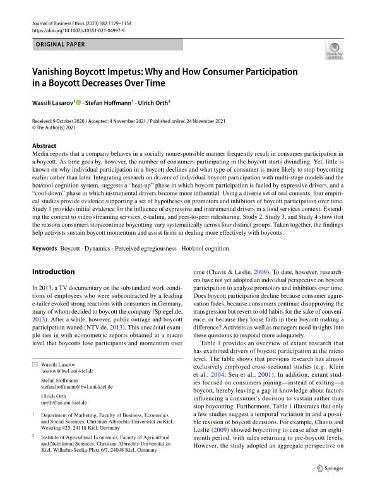
Vanishing Boycott Impetus: Why and How Consumer Participation in a Boycott Decreases Over Time
Media reports that a company behaves in a socially nonresponsible manner frequently result in consumer participation in a boycott. As time goes by, however, the number of consumers participating in the boycott starts dwindling. Yet, little is known on why individual participation in a boycott declines…
Dordrecht: Springer Science and Business Media LLC, 2023
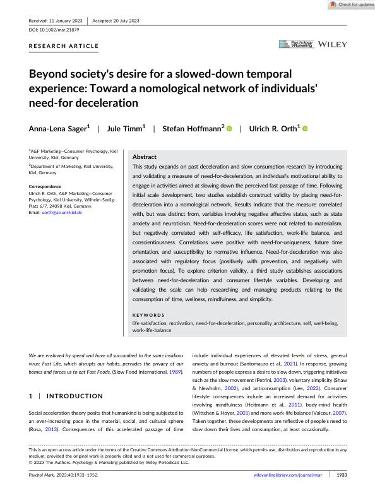
Beyond society's desire for a slowed‐down temporal experience : Toward a nomological network of individuals' need‐for deceleration
This study expands on past deceleration and slow consumption research by introducing and validating a measure of need-for-deceleration, an individual's motivational ability to engage in activities aimed at slowing down the perceived fast passage of time. Following initial scale development, two studies…
Hoboken, NJ: Wiley, 2023
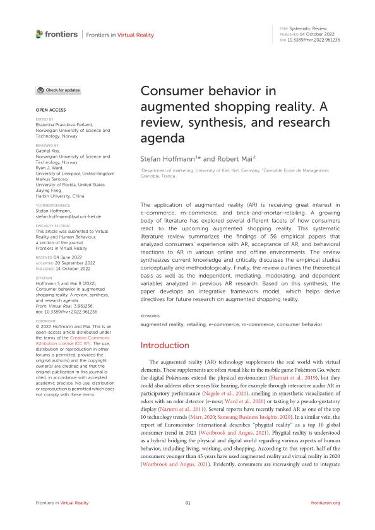
Consumer behavior in augmented shopping reality : A review, synthesis, and research agenda
The application of augmented reality (AR) is receiving great interest in e-commerce, m-commerce, and brick-and-mortar-retailing. A growing body of literature has explored several different facets of how consumers react to the upcoming augmented shopping reality. This systematic literature review summarizes…
Lausanne: Frontiers Media SA, 2022
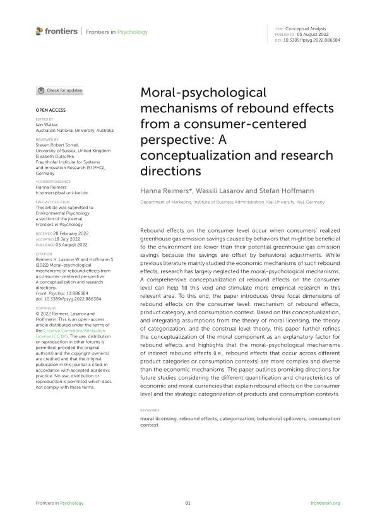
Moral-psychological mechanisms of rebound effects from a consumer-centered perspective : A conceptualization and research…
Rebound effects on the consumer level occur when consumers’ realized greenhouse gas emission savings caused by behaviors that might be beneficial to the environment are lower than their potential greenhouse gas emission savings because the savings are offset by behavioral adjustments. While previous…
Lausanne: Frontiers Media SA, 2022