
11 Dokumente gefunden
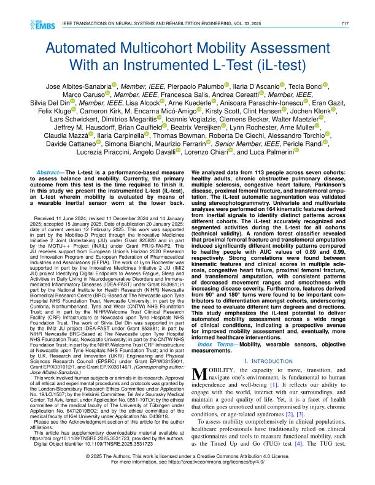
Automated Multicohort Mobility Assessment With an Instrumented L-Test (iL-test)
The L-test is a performance-based measure to assess balance and mobility. Currently, the primary outcome from this test is the time required to finish it. In this study we present the instrumented L-test (iL-test), an L-test wherein mobility is evaluated by means of a wearable inertial sensor worn at…
New York, NY: Institute of Electrical and Electronics Engineers (IEEE), 2025
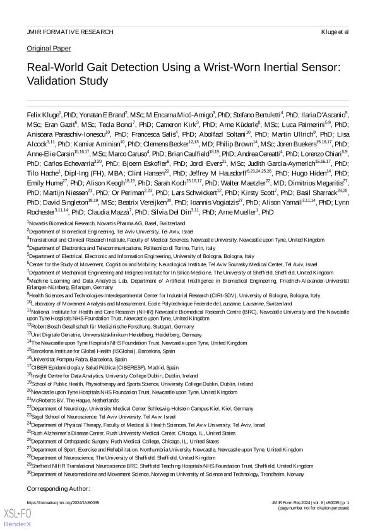
Real-World Gait Detection Using a Wrist-Worn Inertial Sensor: Validation Study
Wrist-worn inertial sensors are increasingly used to assess mobility in real-world settings. Reliable gait sequence (GS) detection is a prerequisite for estimating gait parameters, but remains challenging at the wrist due to complex arm movements. While gait detection algorithms exist for other sensor…
Toronto: JMIR Publications Inc., 2024
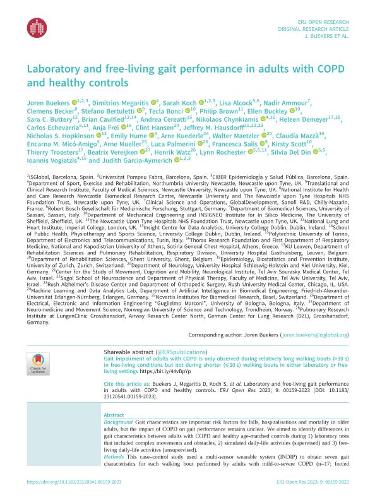
Laboratory and free-living gait performance in adults with COPD and healthy controls
Background Gait characteristics are important risk factors for falls, hospitalisations and mortality in older adults, but the impact of COPD on gait performance remains unclear. We aimed to identify differences in gait characteristics between adults with COPD and healthy age-matched controls during 1)…
[Erscheinungsort nicht ermittelbar]: European Respiratory Society (ERS), 2023
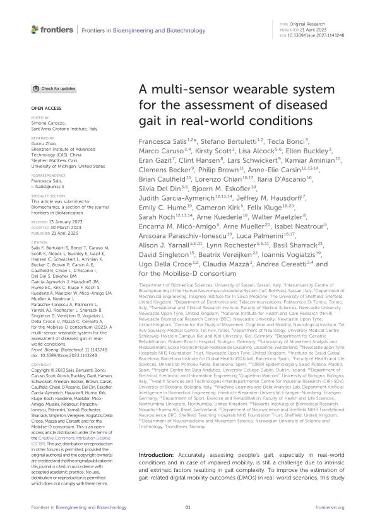
A multi-sensor wearable system for the assessment of diseased gait in real-world conditions
Introduction: Accurately assessing people's gait, especially in real-world conditions and in case of impaired mobility, is still a challenge due to intrinsic and extrinsic factors resulting in gait complexity. To improve the estimation of gait-related digital mobility outcomes (DMOs) in real-world scenarios,…
Lausanne: Frontiers Media SA, 2023
Assessing real-world gait with digital technology? Validation, insights and recommendations from the Mobilise-D consortium
Digital mobility outcomes (DMOs) derived from wearable data require technical validation. This study comparatively assessed DMOs estimated from real-world gait data across six cohorts, focusing on gait sequence detection, initial contact detection (ICD), cadence (CAD), and stride length (SL). Twenty…
London: Springer Science and Business Media LLC, 2023
Ecological validity of a deep learning algorithm to detect gait events from real-life walking bouts in mobility-limiting…
Introduction The clinical assessment of mobility, and walking specifically, is still mainly based on functional tests that lack ecological validity. Thanks to inertial measurement units (IMUs), gait analysis is shifting to unsupervised monitoring in naturalistic and unconstrained settings. However, the…
Lausanne: Frontiers Media SA, 2023
An Algorithm for Accurate Marker-Based Gait Event Detection in Healthy and Pathological Populations During Complex Motor…
There is growing interest in the quantification of gait as part of complex motor tasks. This requires gait events (GEs) to be detected under conditions different from straight walking. This study aimed to propose and validate a new marker-based GE detection method, which is also suitable for curvilinear…
Lausanne: Frontiers Media SA, 2022
Design and validation of a multi-task, multi-context protocol for real-world gait simulation
Background Measuring mobility in daily life entails dealing with confounding factors arising from multiple sources, including pathological characteristics, patient specific walking strategies, environment/context, and purpose of the task. The primary aim of this study is to propose and validate a protocol…
London: Springer Science and Business Media LLC, 2022
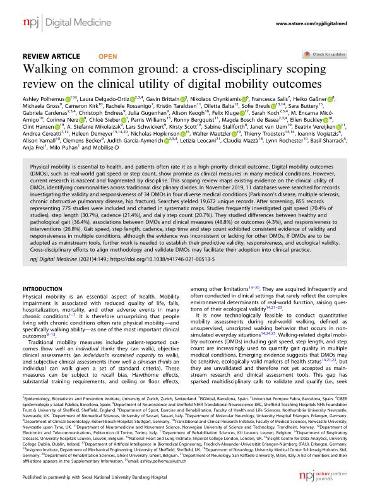
Walking on common ground: a cross-disciplinary scoping review on the clinical utility of digital mobility outcomes
Physical mobility is essential to health, and patients often rate it as a high-priority clinical outcome. Digital mobility outcomes (DMOs), such as real-world gait speed or step count, show promise as clinical measures in many medical conditions. However, current research is nascent and fragmented by…
[Basingstoke]: Springer Science and Business Media LLC, 2021
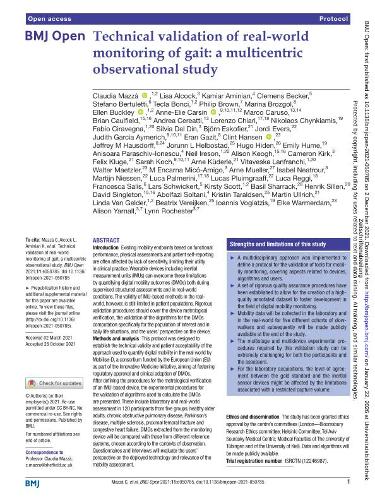
Technical validation of real-world monitoring of gait: a multicentric observational study
Existing mobility endpoints based on functional performance, physical assessments and patient self-reporting are often affected by lack of sensitivity, limiting their utility in clinical practice. Wearable devices including inertial measurement units (IMUs) can overcome these limitations by quantifying…
London: BMJ, 2021
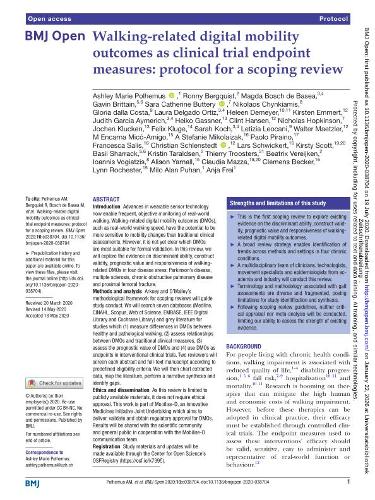
Walking-related digital mobility outcomes as clinical trial endpoint measures: protocol for a scoping review
Advances in wearable sensor technology now enable frequent, objective monitoring of real-world walking. Walking-related digital mobility outcomes (DMOs), such as real-world walking speed, have the potential to be more sensitive to mobility changes than traditional clinical assessments. However, it is…
London: BMJ, 2020