
16 Dokumente gefunden
Einfluss der hepatischen Mikroumgebung auf das Migrationsverhalten prämaligner und maligner Pankreasgangepithelzellen
Ziel der vorliegenden Studie war es, zu untersuchen, welchen Einfluss die Lebermikroumgebung auf EMT und Migrationsverhalten von PDEC hat. Prämaligne (H6c7-Kras) und maligne (PancTu1) PDEC wurden indirekt mit hepatischen Sternzellen (HSC) oder hepatischen Myofibroblasten (HMF) cokultiviert. Dabei stellten…
Longitudinal T cell receptor repertoire analysis in immunotherapy of HER2-positive breast cancer
Breast cancer is the most common malignant disease in women. Certain subtypes of breast cancer, like HER2-positive breast cancer overexpressing the receptor HER2, are treated using neoadjuvant immunochemotherapy containing anti-HER2 antibodies. T cells are immune cells identified by a T cell receptor,…
Characterization of the intratumor microbiome in pancreatic cancer patients and infection models
Diese Dissertation untersucht das intratumorale Mikrobiom beim duktalen Pankreasadenokarzinom (PDAC). Zunächst wird die Rationale für die Mikrobiomanalyse dargelegt: Klinische und immunhistochemische Parameter allein konnten die unterschiedlichen Überlebenszeiten einer gut charakterisierten Patient:innenkohorte…
Insights into the role of hepatic stromal cells and the immune checkpoint protein PD-L1 in liver metastases of pancreatic…
PDAC is the 7th leading cause of cancer deaths with a 9% 5-year survival, largely due to late diagnosis. The liver is the primary metastatic site, yet how the hepatic microenvironment influences disseminated pancreatic ductal epithelial cells (PDEC) remains unclear. While hepatic stellate cells (HSC)…
Funktionelle Rolle von SHP-2 in der spontanen Resistenzentwicklung unter Imatinibexposition
Durch die Einführung der Tyrosinkinaseinhibitoren in der Therapie der chronisch myeloischen Leukämie verbesserte sich die Prognose der Patienten deutlich. Jedoch zeigte sich, dass einige Patienten eine Resistenz aufgrund der Langzeittherapie entwickelten. Dieser dauerhafte Selektionsdruck ermöglicht…
Tumorbiologische Bedeutung neutrophiler Granulozyten im Magenkarzinom nach perioperativer/ neoadjuvanter Chemotherapie
Das Magenkarzinom ist eine der häufigsten und tödlichsten Krebserkrankungen. Aufgrund der schlechten Prognose kommt der Identifikation neuer diagnostischer und therapeutischer Zielstrukturen eine enorme Bedeutung zu. In dieser Dissertation wurden Gewebeproben von 173 Patient:innen, welche eine neoadjuvante…
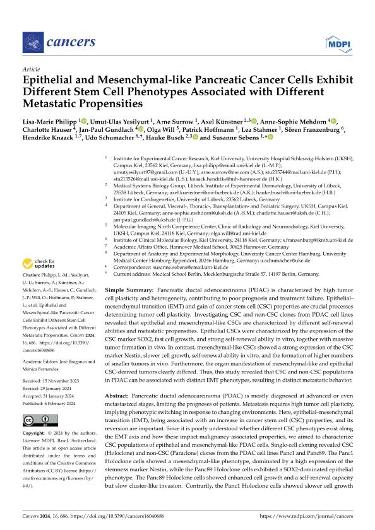
Epithelial and Mesenchymal-like Pancreatic Cancer Cells Exhibit Different Stem Cell Phenotypes Associated with Different…
Pancreatic ductal adenocarcinoma (PDAC) is mostly diagnosed at advanced or even metastasized stages, limiting the prognoses of patients. Metastasis requires high tumor cell plasticity, implying phenotypic switching in response to changing environments. Here, epithelial-mesenchymal transition (EMT), being…
Basel: MDPI AG, 2024
Rekrutierung myeloischer Zellen durch EGFR-gerichtete Antikörper
Mit Cetuximab, Necitumumab und Panitumumab sind drei gegen den epidermalen Wachstumsfaktorrezeptor (EGFR) gerichtete Antikörper für die Behandlung epithelialer Karzinome zugelassen. Während Cetuximab und Necitumumab zum Immunglobulin G (IgG)-Isotyp 1 gehören, ist Panitumumab ein IgG2-Antikörper. Nur…
The impact of the liver microenvironment on the immune checkpoint regulator PD-L1 in liver metastasis of pancreatic cancer
With a 5-year survival rate of under 5 %, pancreatic ductal adenocarcinoma (PDAC) is one of the most fatal malignancies. In the European Union, PDAC represents the 4th most common cause of cancer-related deaths. Lacking specific symptoms, PDAC is mostly diagnosed at a locally advanced or metastatic stage,…
Metastasierung des duktalen Pankreasadenokarzinoms : Wechselwirkung der hepatischen Mikroumgebung und TRAIL-Rezeptoren sowie…
Das duktale Pankreasadenokarzinom (PDAC) ist die vierthäufigste Ursache krebsbedingter Todesfälle. Es wird meist in einem lokal fortgeschrittenem oder metastasiertem Stadium diagnostiziert. Selbst jene Patienten, deren Primärtumor im Gesunden entfernt wird, entwickeln überwiegend nur wenige Monate post-operativ…
Tumor vaccination : Chitosan nanoparticles as antigen vehicles to promote tumor-directed T cell responses
Tumor vaccination is a promising approach for treatment of cancer. Tumor vaccines sensitize the immune system to tumor-specific antigens and thus enhance CD8+ T cell responses. This immune response’s potency can be increased by a strategy where nanoparticles act as vehicles leading to more efficient…
Insulin Receptor in Pancreatic Cancer-Crown Witness in Cross Examination
Background The proximity of pancreatic cancer (PDAC) to the physiological source of the growth promoting hormone insulin might be exploited by this highly malignant cancer entity. We investigated if (I) PDACs express the insulin receptor (IR) in cancer cells and cancer vasculature, (II) if IR correlates…
Basel: MDPI AG, 2021
Longitudinal Analysis of Circulating Tumor Cells in Colorectal Cancer Patients by a Cytological and Molecular Approach :…
Introduction Liquid biopsies allowing for individualized risk stratification of cancer patients have become of high significance in individualized cancer diagnostics and treatment. The detection of circulating tumor cells (CTC) has proven to be highly relevant in risk prediction, e.g., in colorectal…
Lausanne: Frontiers Media SA, 2021
Initiation of Pancreatic Cancer : The Interplay of Hyperglycemia and Macrophages Promotes the Acquisition of Malignancy-Associated…
Pancreatic ductal adenocarcinoma (PDAC) is still one of the most aggressive solid malignancies with a poor prognosis. Obesity and type 2 diabetes mellitus (T2DM) are two major risk factors linked to the development and progression of PDAC, both often characterized by high blood glucose levels. Macrophages…
Basel: MDPI AG, 2021
Programmed Death-Ligand 1 (PD-L1) Expression Is Induced by Insulin in Pancreatic Ductal Adenocarcinoma Cells Pointing to…
Type-2 diabetes (T2DM) is a risk factor for the development of pancreatic ductal adenocarcinoma (PDAC) and is characterized by insulin resistance and hyperinsulinemia. Besides the well-known growth-promoting activity of insulin or the other members of the Insulin/Insulin-like Growth factor (IGF) axis,…
Basel: MDPI AG, 2021
Chitosan nanoparticles as antigen vehicles to induce effective tumor specific T cell responses
Cancer vaccinations sensitize the immune system to recognize tumor-specific antigens de novo or boosting preexisting immune responses. Dendritic cells (DCs) are regarded as the most potent antigen presenting cells (APCs) for induction of (cancer) antigen-specific CD8+ T cell responses. Chitosan nanoparticles…
San Francisco, California, US: Public Library of Science (PLoS), 2020